I’m going to go ahead and assume that when a lot of people are initially taught how to load a developing reel for 35mm film, they get shown how to do it as follows.
- Remove film from the cannister.
- Cut off the film leader.
- Insert the leader end first into the developing reel.
- Spool the film onto the developing reel.
- Snip the film off the canister spool right before finishing.
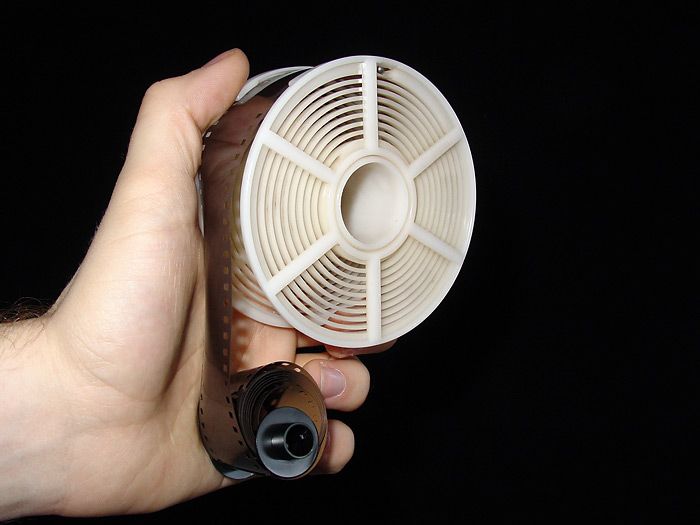
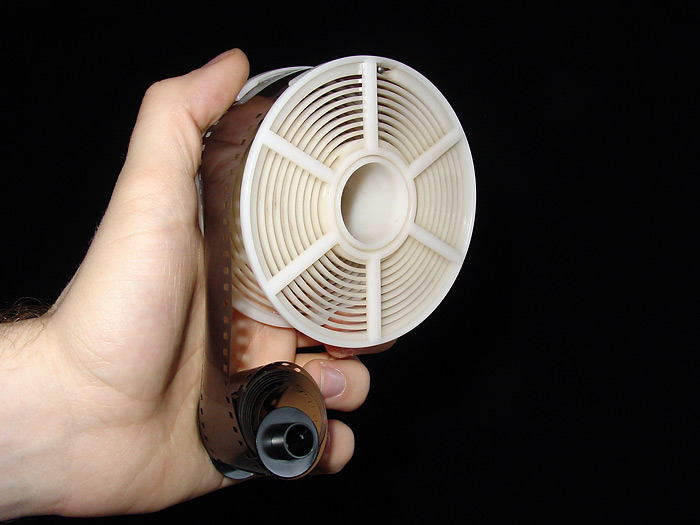
This method may seem fine on paper, but from my hands on experience, I found it to really suck.
For years I just assumed that having the film get stuck 3/4th of the way through the loading process was just something that film photographers had to deal with. With nearly every roll I loaded I would find myself at a point where I had to decide to either keep slowly trying to force the film onto the reel and risk crinkling it, or tearing it off the reel and starting over. Often I’d have to make that decision several times with some stubborn rolls of film that just would not load.
This put me off towards 35mm for years as I hated the constant struggle of loading it. Then one day I had a single, simple revelation about the physical nature of a roll of film, and loading has been a breeze since.
It dawned on me that if I first cut the film off of the canister spool, and then loaded it from that end instead of from the leader end, the natural curl of the film would align better with the spirals of the development reel.
Make sense? If not, here is an image to illustrate what I’m saying.
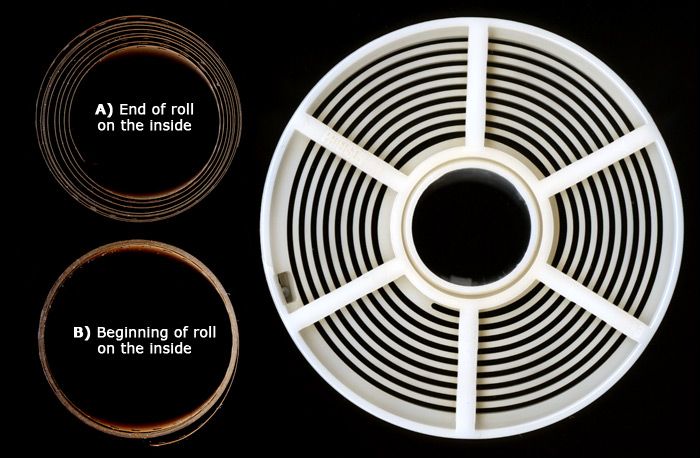
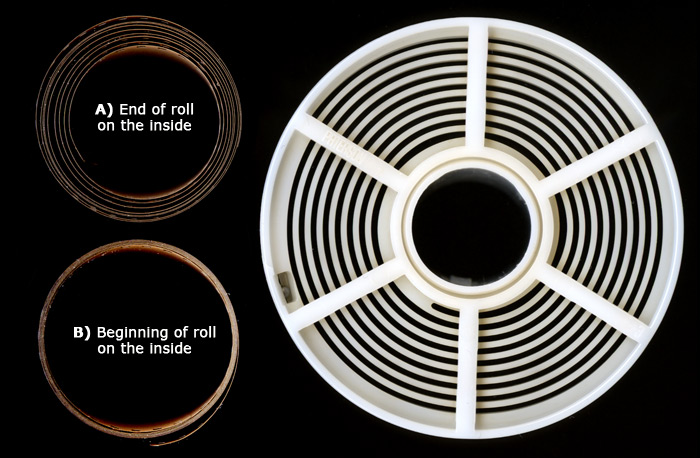
Circle A is a roll of film wound so that the lead end is on the outside, and the spool end is on the inside. Circle B is that same roll of film reversed so that the lead end is on the inside, and the spool end is on the outside.
When a roll of film is loaded using the method that I claim sucks, what results is that the tight circle B has to be forced into the spiral development reel. When loading from the spool end first, then circle A is what ends up being on the development reel. As the image tries to show, this is a much smoother fit.
Loading film for development the easy way
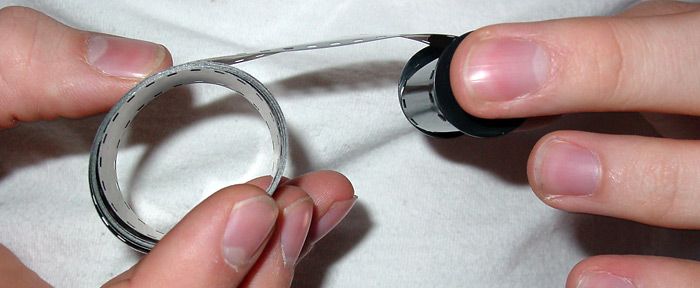
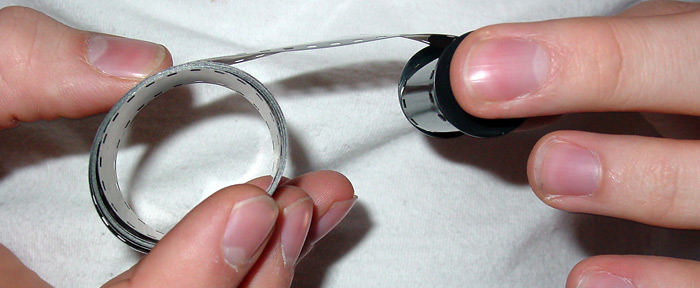
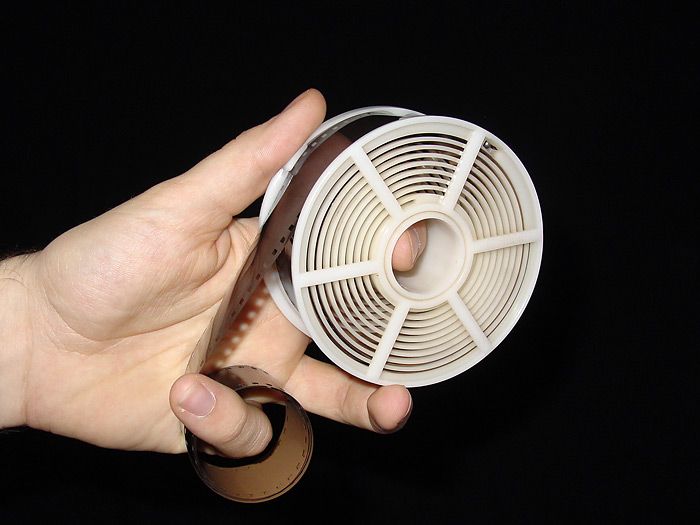
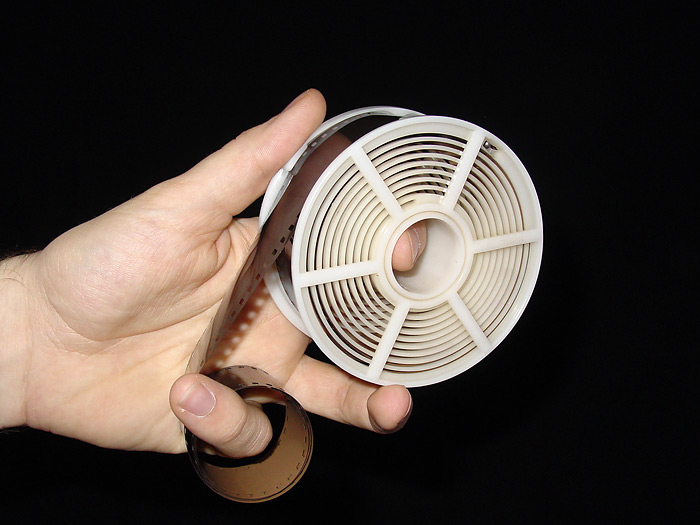
What I do is remove the film from its canister and cut off the leader. Then I reverse the direction of the roll in my hands so that the end of the roll of film is on the outside. At this point I’m holding in my hands what is represented as B in the previous image. I then clip the film off of the spool, and it is smooth sailing onto the development reel.
One other thing that I’ve found with this method is that the film is much easier to manage while trying to get it onto the development reel. By having the film forming a nice tight circle, and not having the spool from the canister in the center of it, I can just slip the film over my little finger while transferring the film onto the development reel. This keeps the film securely in line with the development reel, and completely frees up the other hand for film advancing. Everything ends up staying nice and orderly throughout the process this way.
Switching to this method has led to a massive reduction in incidents where my film seizes up while I’m trying to get it on the spool. This in turn not only saves me time, but also eliminates the frustration of having my favorite photo from a roll end up with a big crescent moon shaped wrinkle right smack in the middle of it.
If you happen to need any more proof of concept, I put together a video for this post showing me load a reel. I’m not trying to show off to break any records in it. This is actually how fast I confidently load my film on a day to day basis.
I am using a Paterson Super System 4 reel here. I own some Paterson System 4 (notice the lack of super) reels as well, and there is no way I could possibly hit this speed with them. In fact, they are so slow and clunky at loading, I’m actually terrified to try and use them. I should just throw them out.
If you’ve ever had the same issues with loading your film like I had, please give this technique a shot the next time you develop. I’d love to hear back and know if you found it any easier to get your film ready for processing.
16 Archived Comments
You saved me today. Thank you. I was all but ready to give up. My initial roll of film got a little scratched and messed up from all the failed attempts, but the second half of it turned out great. It was so easy that I didn’t even hesitate with the second roll I had. The first roll took me probably 40 agonizing minutes to get on (once I tried your method it took like two). The second roll was on in 90 seconds. How is this not common film reel loading knowledge?!
Oh my god, this is a game changer! It's so much easier! I feel betrayed only finding about this now! I found this article after particularly troublesome roll, thinking there has to be a better way, and boy I'm glad there is!
Simply brilliant! I just stumbled onto this nearly 11 years after you had posted this and had to try it out. My film no longer jams 3/4ths of the way on to the spool!! Huge thanks for sacrificing a roll to figure this out and provide valuable information!
Brilliant - so simple! Thanks.
Holy fucking shit! As I read your lines, it was like your READING MY EXACT THOUGHTS. Around 3/4 to the roll I'm getting the jamming too! Especially with Kodak Ektar and Ilford FP4 - because they are 0.125 - 0.130mm thick - so thicker than the usual! I've just developed a roll, will try this very soon!
This should work with 120 right?
Could help. Although with 120 I always just kept the tape that connects the film to the backing paper on the film, and using it to add strength to the leading edge of the film as it goes through the reel. Seemed to work well to prevent it from bending out of shape.
Great tip. I find that it's important to keep the reel completely dry, so the film won't stick to itself during loading.
Wow, fantastic tip. For the first time ever my film went on the reel in about 20 seconds flat without restarting 10 times. Amazed how well this works. Thank you!
Thank you, you saved me from freaking out when loading film! Great trick.
This is a fantastic tip! Also seems like this would help with the film sticking to itself as you wind it in.
Oh my! Just tried this on a test roll. It works magnificently good! Can’t wait to try it under “real world” conditions in the dark room. Thanks for sharing!
Very interesting. I have the same issues going on here but I just chalked it up to inexperience. I was worried about fingerprints too but if thats not an issue I will try this next time I develop.
Thanks for posting.
Have to try this… i have had the same problem. I’m shooting more and more larger formats due to frustration in A) scanning 35mm B) loading it on some of those damn reels.. sometimes is just say f** it and cut the film and throw it at my walls… i doesn’t help though.
I have learned since that scanning 35mm film is waste of time, I’ll just make small prints and scan them when needed.
Don’t you get fingerprints on the film reversing it as shown in the photo?
Nope. Fingerprints on the film before exposure will mess with the light hitting the film and leave marks.
Finger prints made after exposure just wash off during developing.