Sometimes I'll find myself watching videos of photographers such as Jeff Mermelstein, or Joel Meyerowitz doing street photography in New York City. Every time I watch these videos and see their shooting conditions, I can't help but think that the street photographers doing this type of shooting in major metropolitan areas have it easy.
Recently I read a comment elsewhere about the street photographers of New York City. The comment mentioned how some of them will load their camera, walk a block, and by the end of that block have used up all thirty-six frames. This is totally believable when all I see in these videos is an endless glut of people flowing past the street photographer. Hardly any of these people seem to be paying any attention to anything besides themselves, which make for a steady stream of easy targets to be photographed. This got me thinking about my own shooting conditions here in the Zenith City.
On a typical day between work and home I walk about sixteen city blocks. This converts to just a smidgen under two miles, most of which is in what is considered our downtown area. On a busy day, I might cross paths with ten people. Of those ten, a good seven of them will have me in a stare down from a block away as we draw closer to each other. This makes any form of stealth via blending in with the crowd before or after the shot completely impossible.
As time goes by I do find myself getting more confident about shooting during these situations which can feel more like an old west shootout at high noon than a happenstance passing of strangers. Though I get the feeling that these situations seem to be far more personal moments between myself and the subject than what I see in the New York City street photography videos. Each time I do end up taking the shot during these encounters, I can't help but wonder if cutting my teeth on them will ultimately make me a stronger street photographer than I would be if I only had large anonymous crowds to work with? In the rare situations when a crowd does form around here, it feels so easy to use it to get eight feet in front of someone and start shooting, as well as to escape back into after the photographs have been made.
When the situation is only myself and one other person in a visible two block radius, taking that same photo from eight feet away just seems to require jumping over a much larger mental hurdle. As a payoff, it always feels like I gain more street photography experience when I take photos in these sparse conditions, as opposed to shooting during large crowds where it is easy to go unnoticed.
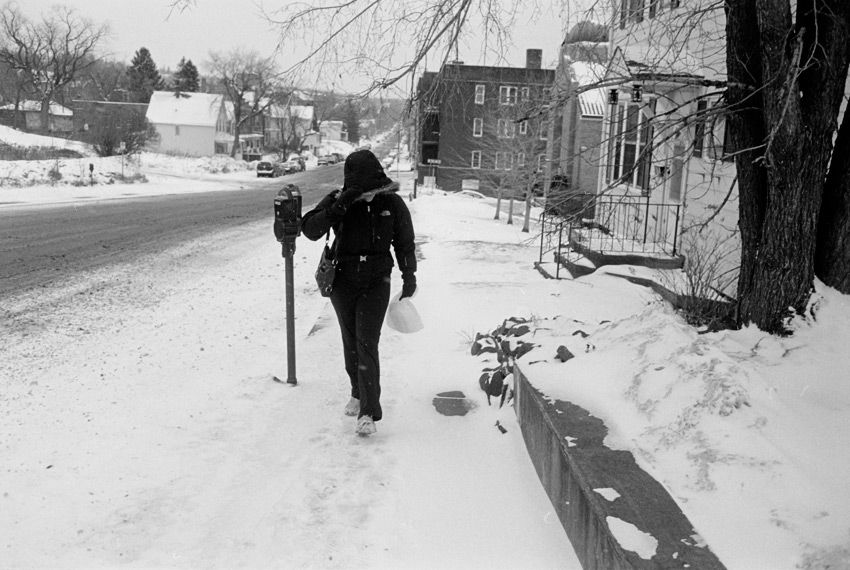
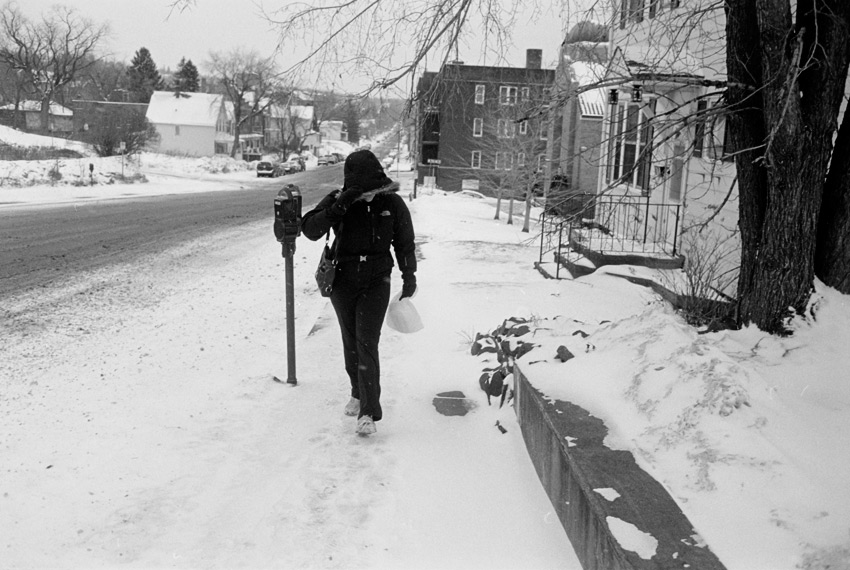
I'm not sure if time will ever answer this question for me. But in the meantime, here is a photograph from a typical encounter from my walk to work. This one was easy since the wind was whipping so hard she kept her hood pulled over her eyes.
23 Archived Comments
K.
Thank you for responding.
I think it’s great that we can discuss the mental process that we each use in our approach. We’re each after our quarry. Sometimes we think we know what it is, other times it’s unconscious – and we approach it in our own ways….
some take a direct approach, others a more oblique path.
I think that both ways can work. If I may use an analogy… look at the animal kingdom – at how nature has adapted to the problem.
The approach of the lion – stalk, then pounce
The spider – compose and wait
The ox or bull – grazing
The lizard – tongue sniper
The monkey – forage for fruits and nuts
The honey bee ….
They are each successful in their own way.
Of course, these are all analogies of obtaining which can be a limited way of approaching photography.
other analogies:
detached observer / witness
may I have this dance?
communal vs. individual approaches.
Joe,
Everything you just described is, as you said, “People going about their business.” I can’t really comment on your work, but I suspect that if you compare the shots that you made using your methodology the other day to the work of Mermelstein Gilden, or Winogrand your images will be clinical in comparison. Why? Because they are so driven to capture the “heart” of their subjects that they overcome a natural human fear as a matter of course. The willingness to expose yourself is a minimum requirement of good street photography.
Jason
Jason,
Thank you for responding to these comments!
Your statement: “The willingness to expose yourself is a minimum requirement of good street photography” is a provocative thesis.
Can you expand on the idea?
Joe
The concept that a street photographer should remain invisible is one I find decays away a little bit each day. I don’t like confrontation, but I find it to be worse if the confrontation starts with someone noticing my attempts at being invisible. They have to wonder “Why is that person being sneaky?” At the same time, I don’t like it as I feel it projects to anyone who notices that I have some dubious use planned for the photos so I have to hide. Making sure they notice that I notice that they noticed and giving a grace period for any questions to be asked goes a long way.
Lately my methodology has been that the more visible I am the better. Know what it is I want to achieve with street photography, and feeling that I don’t need to be invisible to do so has sort of been a leveling-up moment. Using huge cameras has helped, and just in case that isn’t enough, adding flash makes sure I’m not hidden.
Yes, they are.
And you bring up an interesting point about the kinds of people photography on the street, that are possible.
1- People as a part of the urban landscape
2- People going about their business, completely unaware (or forgetting!) that they are being photographed.
3- People reacting to being confronted by the camera/photographer
4- People “allowing” their photo to be taken (going about their business, but aware of the camera).
5- People cooperating in an impromptu environmental portrait
But it seems the original question was on how to approach the situation when there are few people on the street, which makes it much harder to do type #2 (candids). Since they are hihgly likely to see you, the next best approach (besides shifting to types 1,3,4,or 5) is the make yourself invisible after they’ve seen you. They see you and yet don’t see you at the same time. Something about you makes them ID you as innocuous and they forget you’re there.
I did this a few days ago when I came upon a small street carnival in the parking lot of a local mall down here in South Florida. There were very few people at the carnival, just the workers and very few patrons, so there was no way they weren’t going to notice me.
I first made the rounds with my small camera (Panasonic GF1 with 20mm pancake lens) in my coat pocket and walked around as a tourist, played a few of the games the vendors offered, made small talk etc… Then I pulled out the camera and started taking photos of the rides (urban landscapes), moving around getting different angles of the architecture, moving very fluidly, giving rapt attention to the structures and shapes and not looking at any folks. After doing this for a bit, I was loose and relaxed, and everyone pretty much either igorned me, or felt open enough towards me that they wanted me to take their picture – perhaps they thought I was doing something artistic? who knows. But by this point, I could pretty much do whatever I wanted to. Move about, get close, take shots of people, things, landscape, whatever – as I was no longer “on the radar.” This mostly then became people photography of types 1,2 and 5 (above), with probably a bit of 4 as well.
But I guess my point is that if you can get into that fluid unselfconscious flow state, then things can start to happen, and one way is to approach the situation “obliquely” – with your body and mind and camera in constant motion – click-click urban landscape, click candid, click allowed shot, click-click cooperative street portrait, click candid, click urban landscape, all with fluid subtlety as in dancing and enjoying all of it. And when you get home at the end of the day, you’ll have your “street photography” shots.
Joe,
This is just my take on things, but I feel like what you are describing is not street photography. It is cityscape photography (which is a lovely form of photography in and of itself). Essential to good street photography, I think, is the confrontation between the photographer and the subject. If the subject knows they are going to be photographed, they have time to compose themselves and hide their raw emotional state. This, as Kip has said, takes platinum balls.
Street photographers are the close-range assassins of photography.
Jason
Just a few ideas of a couple of things to try when there are few people around:
1. Take urban landscapes using a normal to moderately wide lens and look past the person. Then when you take the photo, it’s an urban landscape with people in it.
2. If they notice you, the urban landscapes motif can be a conversation starter, after which you can ask to take their photo.
3. Don’t stalk or walk towards a person with an intention to take their photo. Instead have a subject which lies in their path. They will come to you and then you can incorporate them into your “urban landscape”.
@Derek: I’ve actually have had someone think a chrome rangefinder was a pistol. http://www.kpraslowicz.com/2009/01/06/luger-vs-leica/ 😀
Great blog. Social anxiety makes for great nature/landscape photography.
I love the analogy of the old west showdown, it feels like that sometimes. When I walk around with a chrome rangefinder around my neck I might as well have a Colt 45 peace maker on my hip. If I hold the camera in my hand people seemed less aware of me/it.
Oddly enough, I can walk around with an SLR and no one pays it any mind. Where I live I guess people are pretty accustomed to seeing nerdy middle aged men and women walking around with dSLR’s and gigantic zoom lenses.
I think crowded streets introduce the problem of weeding out the chaff. Just because there are a lot of people out on the street doesn’t mean you will get winners.
Sure there are a lot of shots to be had but there will be plenty of cliche and uninteresting ones in the mix.
@Glucozze: Thats for the supporting evidence too my post.
Hi !
i was living in Paris two years ago and done a lot of street and protest photography…and it’s true it’s easy you’re among crowd / tourist …everybody have got a camera so you’re in total cover.
(during this time i shoot near 30 000 frames by year spending my afternoons to shoot and my night to work them on CS2)
now i live from two years in a small french city…i make maybe 1000 a year, and i’m like a frozen sheep when i have to shoot someone in the street 😀
(in fact it’s so difficult than now i only shoot posed portrait 😀
by the way here a very interesting link to a street photograph living in somewhere totally unknown:
http://www.flickr.com/photos/polaroidsky/
a little “bordel” and anarchic organisation of the photos in this website but very nice jewells to find here !!
Ha ha. I suppose the prospect of a one-on-one fight, instead of a gang attack by twentyfive people is a plus side I hadn’t considered.
I’ve been working on one handed shooting. I figure if my other hand is on my pocket, I’ll look more casual and be taken less seriously.
I live in New York City, in the Village, so I guess I should have it easy. But, … I don’t. It’s really hard for the opposite reason I think: 25 different people are walking by, and you feel like they ALL see you taking the picture, and I feel like at least one of them is going to alert the subject to my invasion of their privacy…
Sometimes I just take someone’s pic and then look past them, as if I wasn’t looking at them anyways. In NYC, there’s always something better around the next corner. Is that cold!?
All of that said, however, I’ve never been berated or even questioned. So what am I worried about? I think it depends on the person, i.e. I would be freaked out anywhere.
by the way, nice blog! I found you on flickr hand-held large format group…
…cards sound like a good idea to me. Most people don’t know what to make of having their picture taken by a stranger, at least here in Canada. If you can give them the impression that you’re somehow supposed to be there, and you give some legitimate reason for doing it (e.g art, or whatever) they usually go away happy with that. I think business cards would help—In fact I might try that!
Another thing I wrestle with on depopulated streets, apart from the discomfort, is how to render people. In NY you can take 100 photos in an hour all from different angles in different styles and walk away with a few good photos, even if most are throwaways. But on empty streets, there’s so little to work with. I want to keep moving, keep absorbed in what I’m doing, but often it just doesn’t work. I’m wondering if I need to change to doing more street portaits, where I stop people and ask them…. I took a street photography course where the instructor kept saying “get some juxtaposition, get some parallel action” but I kept thinking “there’s no action, period—now what?”
Or perhaps a maniacal laugh followed by the use of some of that exploding flash powder that ninjas use.
One thing I’ve never tried:
Saying “Twenty-three skidoo!”, running in place for 1/2 second kicking up a cloud of dust all around me and then running off with a wacky “P-Schooo!” sound effect.
I’ve have to try that sometime.
Jason
One thing about a black camera is that it doesn’t look “old fashioned”. Cameras are always black or space-age future silver now days. Never chrome. Also, a black Leica makes you turn invisible. Especially if you have an f/1.0 Noctilux on it.
In my limited street shoot experience, I just give a big old Winogrand smile and walk really fast. I try to look like I know what the heck I’m doing. Usually I’m gone before I have to explain.
A few times someone has caught up with me to dress me down. I don’t think my escape route has been the same two times — I’ve claimed to be a student, I’ve sputtered uncontrollably, I’ve openly lied about whether I would use their image, I’ve told them that I was just a hobbyist. Usually my objective is to say ANYTHING so they don’t kill and eat me.
Jason
I sometimes wonder how well it would work to get some cards made up with some nice Martha Stewart looking design on it that just says “Randall J. Poppenfuss, Professional Pervert”.
Think it would take people back just enough to get away?
I had exactly the same thoughts while watching those videos a few months ago. The malls here suck the life out of the streets where I live, and it feels pretty stupid to take a photo of someone who’s been eyeing your camera suspiciously for half a block. But I think you’re right that it’s a good way to build confidence. The other thing is that it requires some adaptation to technique—specifically, you have to develop some sort of communication skills, since it’s far more likely you’ll have to explain what you’re doing. Once you’ve given the spiel a few times, or else perfect that Winogrand smile, shooting one-on-one candids gets easier. (Though still not easy!)
For fear of being that guy I hate to say this, but a black camera might actually help. Last summer when I was toting around a chrome camera, I actually had someone I say something to me along the lines of “I can see that thing two blocks away.”
I just happen to be really lousy at talking to people as well, so if the Winogrand smile don’t work, I keep a stack of nice business cards on me. Being confident and offering a way to contact me seems to take those who do say something off edge. I think more people end up just saying “Thats alright” and deny the card then actually take it.
On the other side of the coin, if you look at Jeff Mermelstein and Bruce Gilden, they shoot ultra-wide angle lenses and sit right on top of their subjects. Heck, Gilden pops a flash in the face of his subject at a distance of three feet. They don’t get close enough to piss off their subjects… they get close enough to get stabbed by their subjects.
Jason