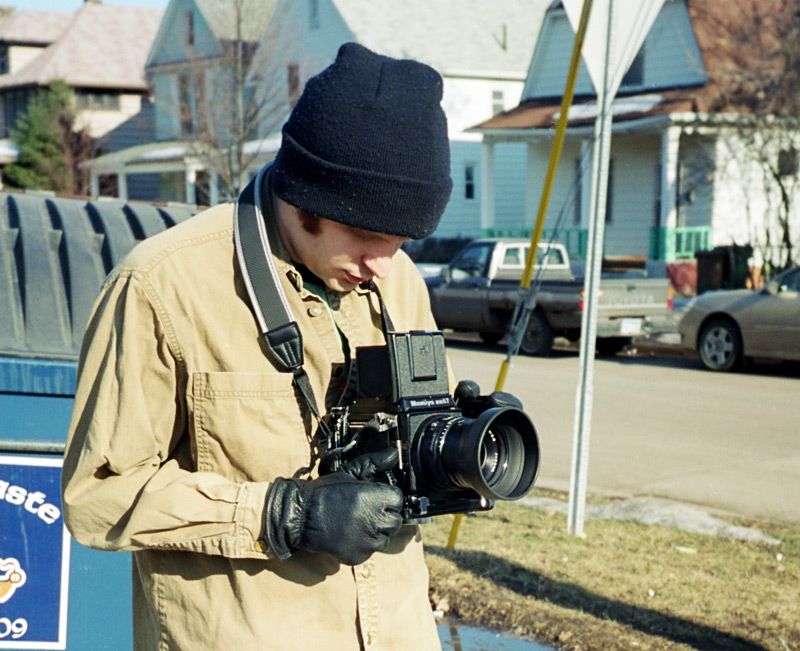
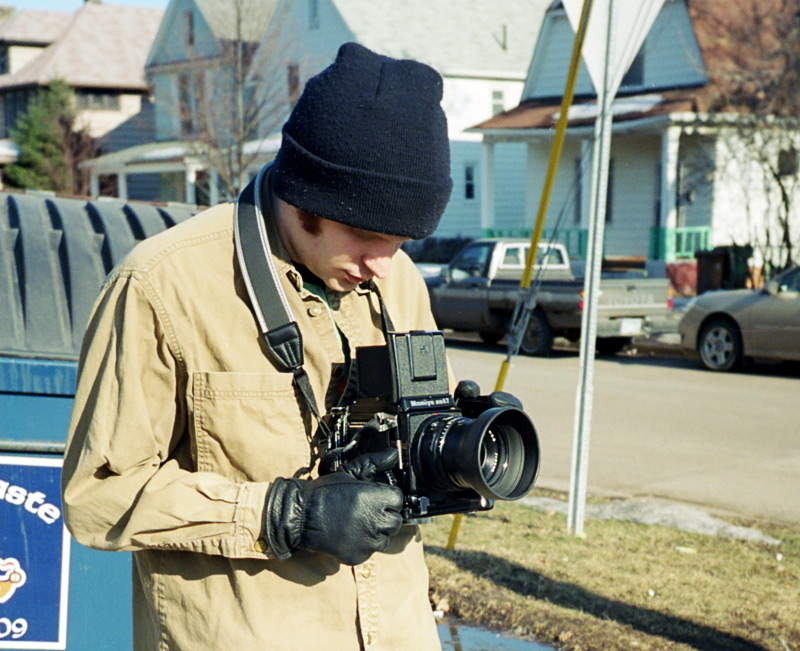
Originally I purchased my Mamiya RB67 medium format camera for night photography on a tripod. However, the masochist in me got excited as soon as I hefted the camera up for the first time. I believe that many photographers would balk at the notion of attempting street photography hand-held with a six-pound camera. I, on the other hand, couldn't wait to give it a try. The wrong tool for the job is often the most fun tool for the job.
Accessorize!
Before taking the RB67 out for some street photography, I believed that a few accessories would make the experience much more pleasant.
The first accessory was a neck strap. The Mamiya RB67 is a heavy camera. I didn’t even want to know what kind of hell I’d experience by attempting to carrying the camera around all day without some support. I ended up getting a neoprene strap for the RB67. It worked well at reducing the apparent weight of the camera while it slung from my neck. The key to purchasing a strap is to make sure to get the correct connectors for the Mamiya's square "Type B" lug posts, such as the Op/Tech strap.
The second is the Mamiya L-Grip for the camera. The L-grip benefits are three-fold.
- It adds a nice handle to grip the camera with.
- It gives the camera a second shutter release for the left hand which I feel is easier to trip.
- It adds a cold shoe for flash use.
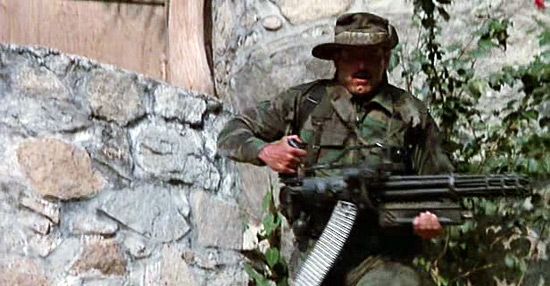
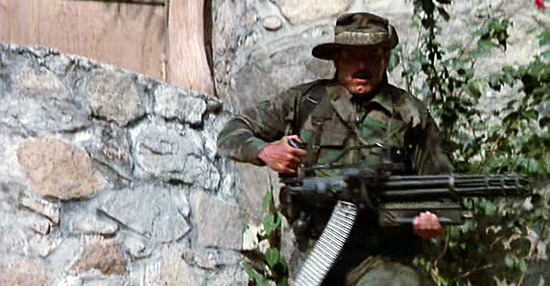
Combining the strap and the grip made using the camera hand-held very manageable. And, as an added bonus, it also made me feel like I was using the XM214 Minigun that Jesse Ventura had in the movie Predator. Remember how awesome that weapon was? Now you too can experience the thrill in photographic form with a Mamiya RB67! (Except for the rate of fire.)
Shooting the Mamiya RB67 Hand-held
For the next few months after getting the rig set up for hand-held use, I periodically took it out into the street for a few street photography sessions. Here is my list of pros and cons from those outings.
Con: It is big and heavy.
The longest photography session I had with the RB67 was at the 2010 John Beargrease sled dog marathon. For that session, I was on foot with the RB67 for a little over three hours. I had a lot of fun shooting with the RB67 that day. It was an outing that proved to me that the RB67 is feasible as a street photography camera. However, I don’t believe I’d ever take it to an event where I’d like to do anything other than shoot photographs. The bulky, heavy camera doesn’t store very well anywhere but in my hands. It also doesn’t easily rest on my hip or sling around to my back as I can do with a TLR or 35mm Rangefinder camera.
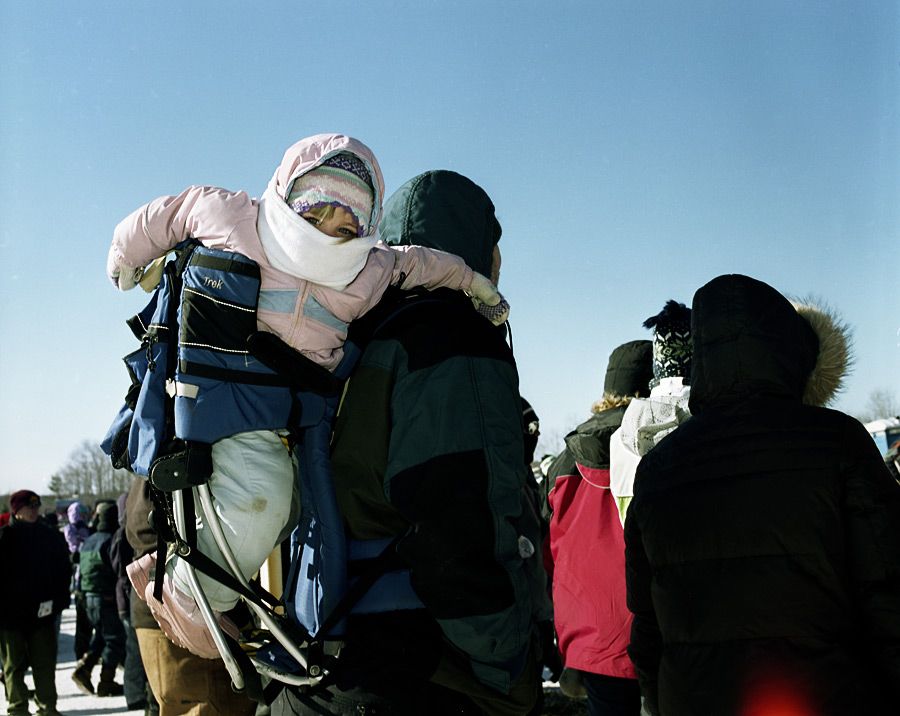
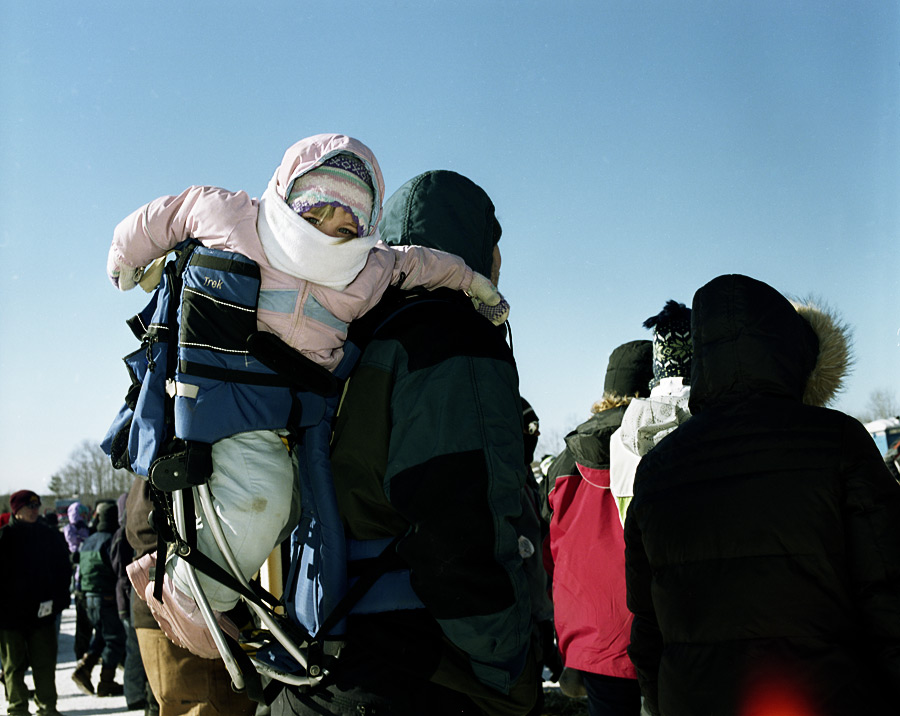
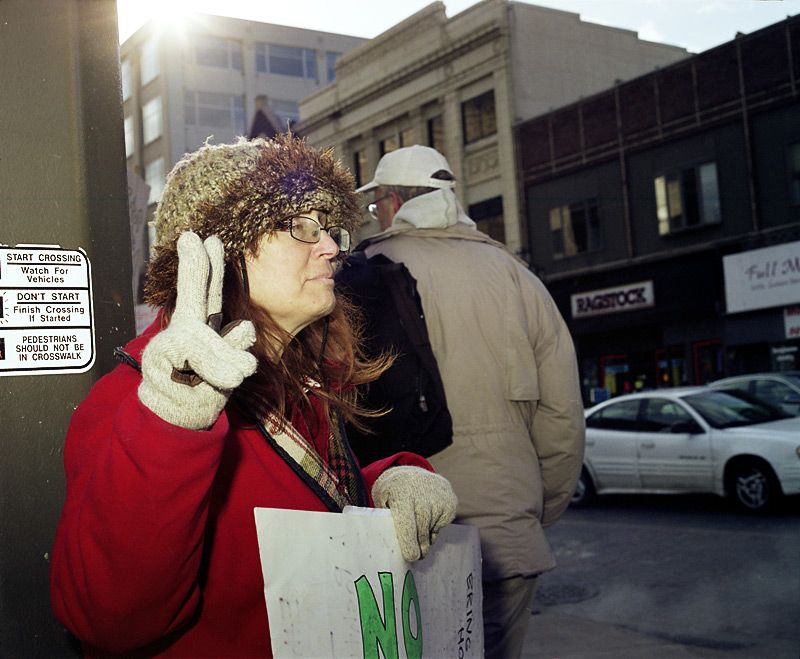
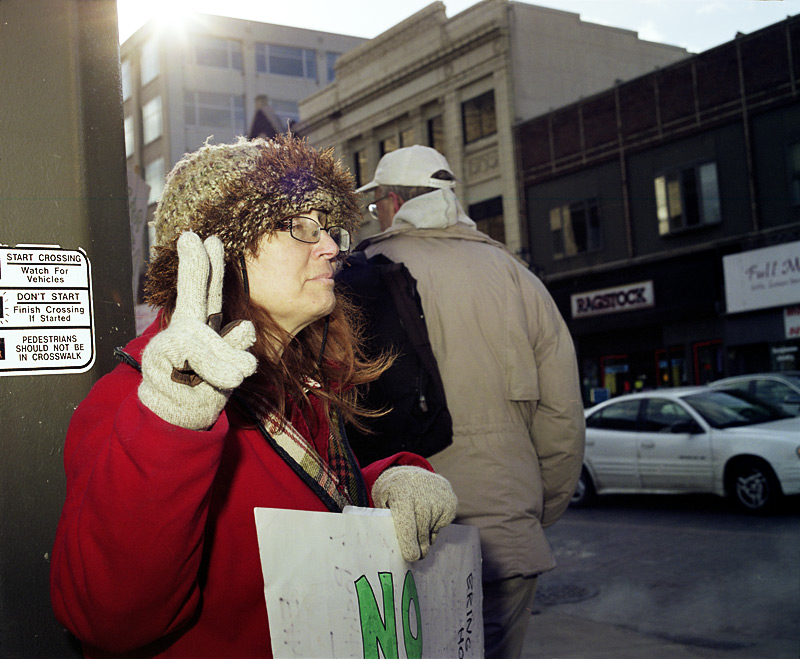
One of the street photographs taken with the Mamiya RB67 at the 2010 John Beargrease sled dog marathon.
Pro: It is big and heavy.
It’s not to say I can’t find any good in its weight and size.
I’m a pretty big introvert. Rarely am I ever the one who starts up a conversation with strangers. The big-bad Mamiya RB67’s size drew in a lot of people and forced them to strike up conversations. I think I've handed out more of my cards while wielding the Mamiya RB67 than I have while out with any other camera in previous years.
I've also been asked if I was a professional at the most frequent rate that I've ever been asked, which I'll also consider to be a good thing. If a photographer can project a sense that they are supposed to be doing what they are doing, it takes the edge off of those who notice. If flashing a big honking camera takes that edge off them for me by making them think I’m a professional—great! I can then expect less strange looks if I were to aim it at people.
Pro: Art with Exercise
After every shooting session with the Mamiya RB67 I felt like I had just completed a cardio workout. Thus, the Mamiya RB67 is a nice multitasking, exercise machine. I get to keep my body healthy and in shape, all while making art!
Con: Shutter Lag
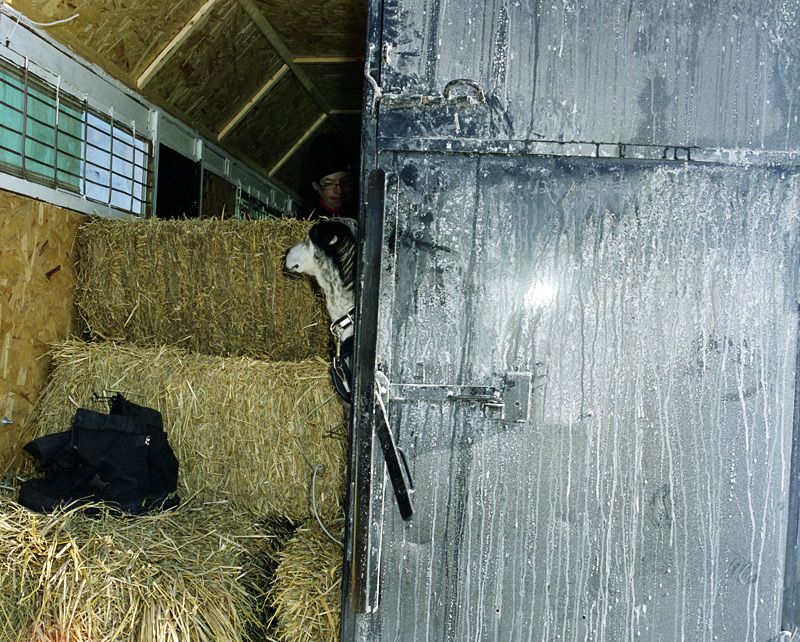
Once the shutter is tripped on the camera, the big SLR mirror needs to get out of the way before the exposure can be made. The time it takes for the mirror to move adds a bit of lag between when the shutter is released, and when the exposure is made. I didn't feel that the delay would be much of a problem when I was dry firing the camera, but using it on the street was a different story.
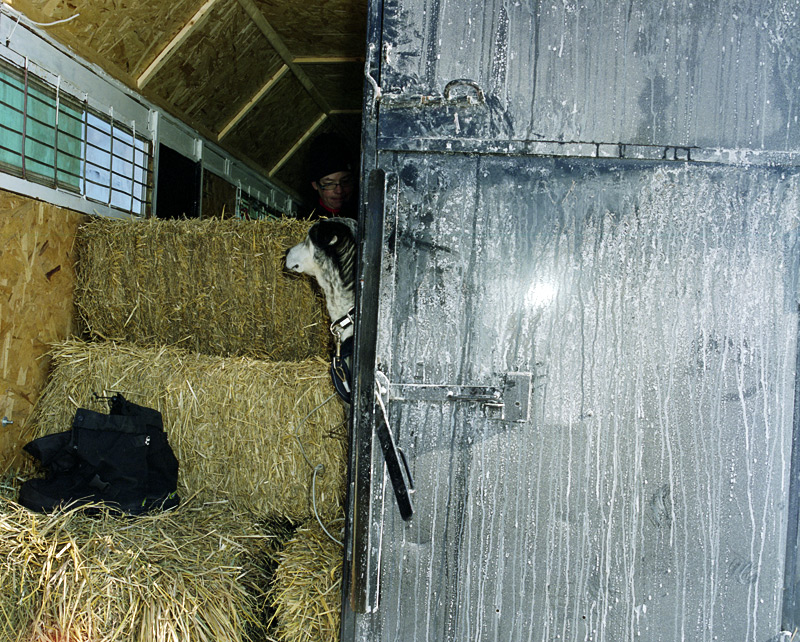
Even though the lag time is only a fraction of a second—it still feels like an eternity in comparison to the nearly instantaneous shutter response time which I’m used to from my Leica or Yashica Mat. If anything fast moving happens, I don’t expect to capture the moment how it looked when I tripped the shutter. Take for example this photo of a dog. It was looking at me when I hit the button.
Con: Viewfinder Blackout
The second downside about the mirror having to move out of the way is that the viewfinder goes black. This played a psychological game with me that I couldn’t seem to get my head around. Instinctively, I would associate the blacking out of the viewfinder with the exposure being made. What would then happen is I’d quickly start moving the camera prematurely thinking the exposure was already done, when in reality the shutter was finally just opening up. This led to a good percentage of images with very noticeable camera shake.
Conclusion
Street Photography is a low percentage game. A lot of photographs need to be taken to get a few keepers, and a camera must always be with you to ensure you can capture the best unpredictable moments of life. While I absolutely love the way that technically sound negatives look, the cons get too much in the way of the street photography odds. Odds which are hard enough to succeed with as it is.
I’ve since taken to my Yashica Mat 124G for heavy medium format street photography use. The negatives might be a little smaller and not as nice, but once I consume the 100 rolls of 220 sized Fuji 400H film that I bought for it, I'll have an additional 400 photos to edit from. And since I can easily take the 124G with me everywhere, I can reasonably expect to be able to consume all that film in the near future. I'll probably still occasionally use the Mamiya RB67 on the street when I feel like doing something different.
Until next time…
8 Archived Comments
Ho yes! The RB is the proverbial revenge of the Japanese. When I go to the field on assignment I have to carry not only the camera but also the 3 lenses, spare backs, prism finder, poly back and the damn heavy tripod!
Nowadays I leave it in the studio where it belongs and take the Nikon 800D with zoom lens for a outing...
What a pleasure!
I agree as well! I’ve gotten the RB recently and find it about he same weight as my 1D with 70-200 - the RB gets me way more interest from folks and quite a way to start a conversation!
I started using a Rolleicord IV (circa 1953) for a bit of street with a short cable release as I found the release lever awkward to use. Looking down into the finder is a very different experience to lifting the camera to your eye. At the moment of exposure I look away from my scene and "click". I also have a Hass 500CM, but my God, the clatter it makes at the critical moment! The Rollei is whisper quiet. It also has an antique look about it and I'm sure people do not perceive any threat from it. It hangs down on an old leather strap and I use it in the leather case, thus it looks very period.
Squeezing the small cable release is very discreet as my hand is quite close to the camera and half hidden by the lens hood. I move away before winding on and retensioning the shutter so hopefully no-one can follow the sequence. Got some good shots with hardly anyone looking towards the camera. I have a Nikon F3 with a WLF and that's a good camera for discreet shooting with a 35mm f2 lens, well stopped down there's little need to focus and on auto the exposure is well taken care of. Rollei takes Ilford FP4 and F3 uses XP2 Super. Not bothered much about colour though used it for E6 in the past and have got thousands of tyrannies to sort through!
I have a few rolls of film i shot on the 645m and some of it was on the street. It made switch up my game plan, i usually walk around and catch images as i go. with the Mamiya i had to wait for the images to come to me. On the 645 the shutter speed goes to 1000 which helps.
I find it pretty heavy after a while so i can imagine that monster around your neck hurtin’.
@Joel. After many a day carrying around a Speed Graphic and all the parts that needs to work, the RB67 is like a compact dream. 😀
I never thought I’d walk around with the RB67 either, but somehow my arms have adjusted to the bulk. I find that I can just cradle the camera for long periods. Having a couple of backs with different films is really neat, too. Especially when one of those is a polaroid back, which usually disarms people pretty quickly (“I remember those!”).
With regard to the shutter lag, sometimes I’ll use the camera in mirror up mode and use my eyes to predict when to trip the shutter, removing the delay. Of course, you lose out on the viewfinder and it is a bit cumbersome, but still…
Jody. I imagine at some point in my life I’ll track down a sport finder for RB67 and try it in mirror up mode. Could be fun to try.
I'm shopping for a microscope adaptor.